Post
Conversation between Alexander and Diogenes in Sanskrit Verse
Introduction
Diogenes the cynic (Διογένης ὁ Κυνικός) seems to be the Internet’s favorite philosopher. He lived around the fifth and fourth centuries BCE with a simple lifestyle, forgoing all pleasures and living, as the name given to him suggests, like a dog. No work ascribed to him survive though they did exist in antiquity. Most of the amusing anecdotes that are circulated about him today are from Diogenes (no relation) Laertius’ Lives of Eminent Philosophers. This work was written around the third century CE. Due to such gap of time, it is unclear whether the anecdotes are historically accurate or are the sort of tall tales that are often attributed to such figures.
In any case, they are what we have to go with and much of Diogenes’ modern fame is based on these anecdotes. They are, I must admit, quite funny. Plato, for example, is once said to have defined human as a featherless biped when Diogenes barged into his Academy with a chicken that had all its feathers plucked and proclaimed,“Behold a man !”. He is once said to have remarked that there was no place in a rich man’s house to spit but for his face.
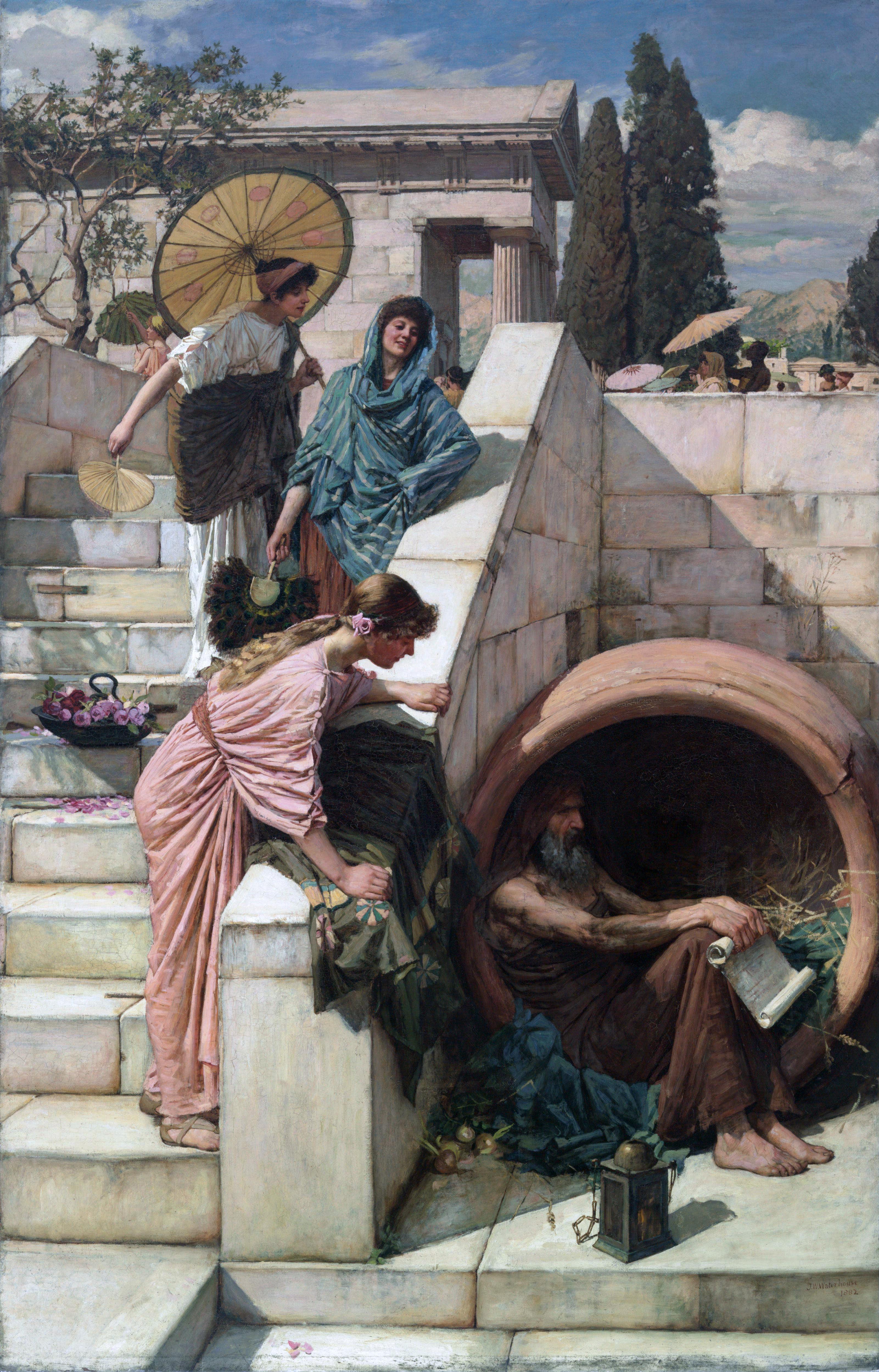
There are a lot of these amusing anecdotes about Diogenes. The most famous one, after the Platonic man incident, was perhaps his meeting with Alexander the Great. It is usually related like this: When Alexander was sometimes at Athens for reasons of his own, he went to Diogenes living in his customary jar and asked whether Diogenes would want something from him. “You stand before me. Move out and give me light.” Impressed by such haughty reply, Alexander says, “Were I not Alexander I would like to be Diogenes.” Diogenes replied, “Were I Alexander, I would like to be Diogenes too.”
Ancient Sources
The elements of this anecdote are present in Laertius’ account of Diogenes but they aren’t actually connected together but are separate.
and later:
Here, the shadow incident and the wish of Alexander to be Diogenes are separated. The combination of these two incidents, as often happens in modern depictions of Diogenes, is present not in Laertius but in Plutarch’s Life of Alexander.
My Poem
Anyway, the purpose of this post is not to trace the history of representation of the meeting between Alexander and Diogenes in ancient sources. The quotes above should provide enough context for my own verses.
I wrote this, if I remember correctly, in 2023 when I first read about Diogenes. The metre is simple Anuṣṭup. There is an extra line in verse 5. I could not fit it otherwise.
Greek names have been naturalized to Sanskrit in various ways and even in the small total of 3 words in as many ways.
Alexander - Alakṣyendraḥ, from Alakṣya (literally un-aimable i.e., unmarked, invisible) and Indra (Indra, Lord. When it occurs at the end of a compound it means ‘best of x’). Hence, literally it means, “best of the unmarked ones” which is weird. It just chose this so that both parts of the compound are real Sanskrit words while the compound itself sounds somewhat similar to the Greek original still.
Diogenes - Devajātaḥ from Deva (God) and Jātaḥ (Born of, Child, Son). This is a sort of calque from the original Greek Διογένης which means God-born. Devajātaḥ is not an actually attested name as far as I know but it seems natural enough to me and fits metre nicely. I tried other translations like Divojātaḥ or Divojaḥ imitating the attested name Divodāsaḥ but using these would either not fit the metre or require using more fillter particles that I wanted to avoid. Even in calque, the individual words that form the compound are, if not exactly cognate, at least from the same ancestral root and share similar sounds.
Athens - āthiṃsaḥ. This one is just a translation. No attempt have been made either to mirror the gender(feminine) or the number(plural) of the original Greek.
Sanskrit Text
svabhāṇḍe varttamānaṃ taṃ devajātaṃ mahīśvaraḥ । alakṣyendro’tha papraccha kvacid āthiṃsam eyivān ॥01 ॥
janānāṃ bahūnām asmi saumyā’haṃ nṛpaśabdabhāk । prabrūhi mama bhadraṃ te kiṃ hanta pradadāni te ॥02 ॥
uttiṣṭhasi mamā’gre’tra tamo mām iha bādhate । ito’pasara maj jyotir yyadi śakto’si dehi naḥ ॥03 ॥
cakitaḥ so’bhimānena tūṣṇīm āśritya ca kṣaṇam । alakṣyendraḥ punaś coce devajātam idaṃ vacaḥ ॥04 ॥
kathañcin nā’bhaviṣyaṃ ced alakṣyendras tato hy aham । bhavituṃ devajātas tad aiṣiṣyam aviśaṅkitaḥ । pratyuvāca tvaram bhūpaṃ devajāto’pi tattvataḥ ॥05 ॥
kathañcic cā’bhaviṣyaṃ ced alakṣyendras tato’py aham । bhavituṃ devajātas tad aiṣiṣyam aviśaṅkitaḥ ॥06 ॥
English Translation
Alexander, the lord of earth, who was once at Athens, asked Diogenes who was in his own jar.
“Over many nations, Sir, do I bear the title of King. Speak forth, I pray, what I should give you.”
“You stand before me here and the darkness troubles me. Move away from me here and give me light if you can do that.”
Amazed by the haughtiness and after being silent for a moment, Alexander spoke these words to Diogenes again:
“If I were somehow not Alexander, then I’d have wished to be Diogenes without a doubt.” Diogenes quickly replied to the king with meaningful words:
“Even if I were somehow Alexander, then I’d have wished to be Diogenes too without a doubt.”
There are a few problems with the Sanskrit text but I am too lazy to correct them now. In any case, it is largely correct; both grammatically and metrically.So, I don’t really have much motivation to do so. I’ll probably publish this in Substack afterwards.