Substack
Odin, Frigg and the Origin (Myth) of the Lombards
A piece of Germanic mythology in Latin
Introduction
The vast majority of our sources for pre-Christian Germanic religion, culture and folklore comes just from the Norse people. The reasons for this are many and complicated and I am not particularly well informed on the subject to give the exact reasons. So, I can only give my personal opinion. The conversion to Christianity of Norse people did happen much later than of the continental Germanic groups or of Anglo-Saxons. Even after the conversion to Christianity, the Norse, and especially Icelanders, seem to have maintained a greater interest in the religion of their ancestors than pretty much all of Europe. So it happens that a majority of surviving textual sources for Germanic religion and myth are biased towards Norse (and especially Icelandic) tradition.
There are, however, some non-Norse sources in a variety of languages. Old English poems often refer to old Germanic heroes1. Beowulf, for example, is both set in Scandanavia and referencess to a host of characters that are often known later in Norse poetry and sagas. It even contains the first literary mention of the famous Volsung cycle. From Germany, there are some shorter charms that are quite important for the study of folk-healing practices but the epic traditions of the Nibelungs, Dietrich von Bern and similar figures are more prominent.
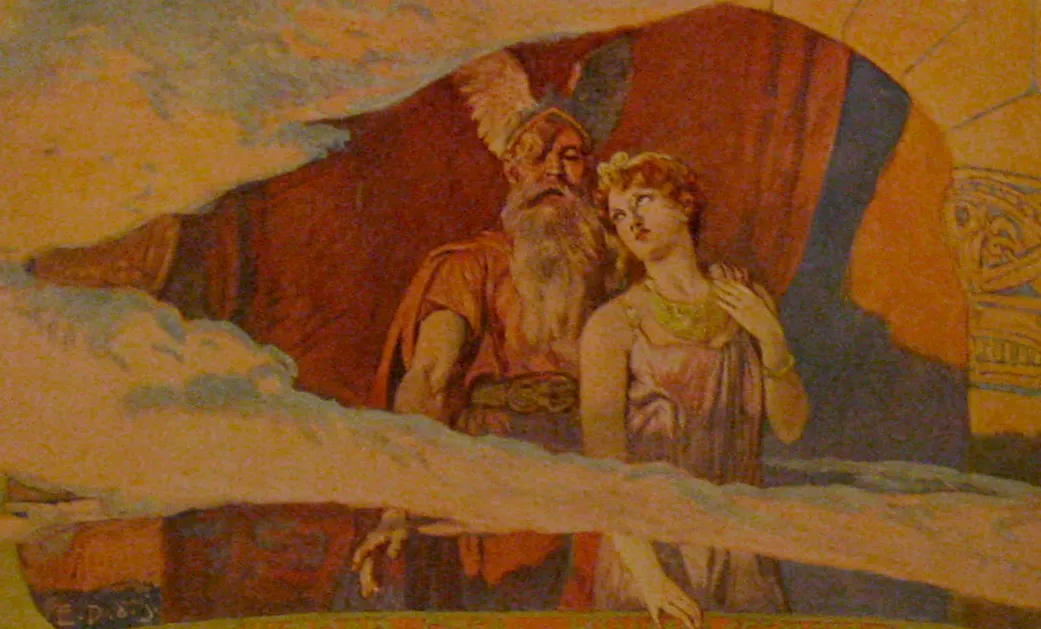
Latin, though not a Germanic language, might be behind only Old Norse in terms of source volume. From Tacitus’ Germania in the first century CE to Saxo’s Gesta Danorum (Deeds of the Danes) in the thirteenth, various accounts of pre-Christian Germanic peoples and their customs in Latin, both by outsiders and insiders, survive.
In late antiquity, various people-groups in Europe and western Asia impelled by a whole host of reasons moved out of their lands and migrated, in a period often called the Migration Period (or Völkerwanderung ‘Wandering of the People’ in German). A number of these, mostly Germanic peoples, settled and then carved out their own kingdoms as the Roman Empire faded away in the fifth century. Goths and Franks are the more well known but there were plenty more. When Byzantine reconquest of Italy (535-553 CE) devastated much of Italy, leaving both the Goths and the imperialists in a reeling state in its aftermath, Lombards invaded and settled large parts of the peninsula (568 CE). The kingdom of the Lombards would survive upto the eight century when it was finally conquered by Charlemagne.
These Lombards, like the Goths who had invaded Italy a century prior, were a Germanic people. Like the Goths too, they claimed to be descended from people who had migrated from Scandanavia. Although the majority of the Lombards were probably Christians by the time they invaded Italy, their origin myth still deals with their pre-Christian gods and thus make for interesting reading.
Origin of the Lombard People
The major source for this origin myth is the anonymous Origo Gentis Langobardorum (Origin of the Lombard people), dating from the 7th century. The first part of this short text contains the origin myth of the Lombards. The text is given in the original Latin and in an English translation2.
Latin Text
English Translation
Some Comments
The island of Scandan is obviously Scandanavia. The Wandals who fight against the Winnils are probably the Germanic tribe of Vandals who in the twilight years of the Western Roman Empire conquered the province of Africa (in todays Tunisia and neighboring parts). Words like ‘vandal’ and ‘vandalism’ supposedly testify to their rather destructive rule as foreign military elite.
The name of the first of the two gods in this little story is likely familiar to anyone interested in Norse myths. Godan is the Lombard name of a god common to a host of different Germanic people. Odin (from Old Norse Óðinn) is perhaps the most common form of this name encountered in modern English though Wodan is sometimes seen in older books. He was known as Wōden in Old English, Wōdan in Old Saxon, and Wuotan in Old High German, all from Proto-Germanic *Wōðanaz. People familiar with Wagner’s operas might know the modern German form Wotan. Godan, then, is the Lombard form of the god’s name. This little story is one the earliest mention of Odin in a literary source3, though there are earlier runes that mention him.4
The second one looks familiar too. Frea sounds similar enough to Old Norse Freyja. But the exact linguistic cognate of Frea here is apparantly not Freyja but Frigg. I’m not a historical linguist, so, I can’t present what sort of laws of sound changes are involved here but it seems to be the scholorly consensus. Frigg is, like Frea here, the wife of Odin in what we know of Norse mythology in later times. In this context, it’s interesting to note that some scholars have speculated that Frigg (meaning ‘lady’) and Frejya (meaning ‘dear’) might have been two names or epithets of the same goddess and that were later reinterpreted as two distinct goddesses. Though there are some interesting hints for this in the Old Norse corpus (Frejya’s husband Óðr, for example, is most probably Odin himself), they seem to have been treated as two distinct characters by the time we get Eddic poetry. I wonder whether or not Frigg and Freyja were distinct for the author of Origo.
An interesting point is Frea’s reasoning when asking Godan to give victory to the Winils. And Frea said to Godan, “Just as you have given them a name, give them victory as well.” It might not be clear why exactly giving someone a name would necessarily imply giving them some another gift (victory in this case) as well. I think the reason behind it could be connected to the naming ceremony for newborns. At least in Old Norse sources, newborns seen to have been given some sort of gifts both by their parents and also by the guests present during the ritual. Of course the longbeared Winils are not literally newborns but giving a new name and identity, as Godan does here, might be the ocassion for giving gifts to the newly named ones nonetheless. Of course, it might not be actual usual practice but it seems likely to me nonetheless.
The eddic poem Helgakviða Hjörvarðssonar ( The Lay of Helgi, son of Hjorvard) contains a passage that supports this theory. The hero Helgi never speaks a word from his birth and no name is given to him by his parents. Later (the time is not specified but he seems to be a young man already) he encounters a group a valkyries and one of whom calls him with the name Helgi. He, however, says that he won’t accept whatever gift she will give him after giving him a name unless he can have her.5
King Hjǫrvarðr married Sigrlinn, and Atli Álǫf. Hjǫrvarðr and Sigrlinn had a son mighty and handsome. He was silent. No name stuck to him. He sat on a burial mound. He saw nine valkyries riding, and one was the noblest. She said:
6.‘You’ll be late, Helgi, to rule rings, mighty strife-apple-tree, or Rǫðulsvellir — an eagle screamed early — if you always keep silent, even if, king, you prove your hard heart!’
7.‘What will you let accompany the name “Helgi”, bright-faced bride, since you have the authority to offer? Think well before all decisions! I won’t accept it, unless I have you!
Paul the Deacon’s History of the Lombards
Paul the Decacon’s late eigth century Historia Langobardorum (History of the Lombards) gives a similar origin story in its first book. Paul, however, as a highely educated man of his time and a Christian deacon doesn’t just pass over the story in a mostly neutral way, like the anonymous author of the Origo, but comments on the its ridiculousness. He has his own take on why Lombards were called so. Using interpretatio Romana, he identifies Godan with the Roman Mercury and inheriting a Christian tradition of euhemerizing pagan gods corrects, so to speak, his source that Godan (or Mercury) lived as a man in Greece in far earlier time period than the one in his narrative6.
Latin Text
English Translation
Some Comments
The general story as recounted by Paul is, notwithstanding some minor spelling changes, quite similar to the one in Origo. The major change is the setting. Paul’s Winils fight the Wandals in a land called Scoringa after having migrated from Scandanavia whereas in Origo, they migrate after their victory. It isn’t certain where exactly this Scoringa is located but considering the later movement of the Lombards, somewhere in the Baltics seem to be a good guess.
The other major difference, of course, is the atitude of the writer towards the traditional story. As stated earlier, while the anonymous author is mostly neutral in his retelling, Paul goes out of his way to discredit it, calling the story ‘ridiculous’ and ‘good for laughs and worth nothing’.
Paul also mentions in passing that Godan lived in Greece and not Germany. This relies on the idea called euhemerization. Called after the Greek philosopher Euhemerus ( third century BCE), it considers gods and other divine and supernatural beings to be but vaguely remembered memories of some men, great kings and like, who lived in the distant past and were only mythologized later. Euhemerus supposedly argued that Zeus was a great king whose deeds led later generations to deify him and that his tomb was at Crete. Although not as popular in pre-Christian Graeco-Roman world as some people seem to think, euhemerization is widely discredited today as a viable theory in the study of religions. In ancient and medieval times, however, Christians widely used euhemerization to prove the misguidedness of worshiping pagan gods like Zeus and for the clear superiority of their own God.
In relation to Germanic religions in particular, both Snorri Sturluson in his Prose Edda (and Heimskringla) and Saxo Grammaticus in his Gesta Danorum offer a euhemerized account of the Norse pantheon. Snorri, for example, provides a detailed account relating how Odin was originally a Trojan who migrated northwards and connects, using folk etymology, the Aesir with Asia and the Vanir with Danais (the Don river in Russia).
Whatever Paul’s own thought on the story, his source must have been either the Origo itself or something extremely similar to it.
Gothic Chronicle
The Historia Langobardorum codicis Gothani (The History of the Lombards contained in the Gothic codex) or the Chronicon Gothanum (Gothic Chronicle) is an early ninth century history of the Lombards from the beginning to the end of their kingdom in Italy. It was written by an anonymous author in the first decades of the ninth century under Pippin of Italy. Answering a call for help from Pope Adrian I, Charlemagne had conquered the Lombard kingdom in the 770s. In 781, Pippin was crowned as the King of the Lombard kingdom. The Chronicle was thus written for Peppin as the new King of the Lombards and favor the Carolingians over the Lombards.
Unlike Paul the Deacon’s history written just a decade or so prior, Chronicon Gothanum contains a strikingly different account of the origin of the Lombards. 7
Latin Text
English Translation
Some Comments
The account of the Chronicon Gothanum doesn’t contain the Godan myth at all. I’ve included it in the article because of the phrase “sed phitonissa inter sibillae cognomina” “but pythia among the names of the sibyll”. Gambara is here not only the ancestress of the Lombards as in other accounts but also a sibyll or pythia. Both these terms have something to do with oracles or clarevoyance. Pythia was the priestess of Apollo at Delphi and gave oracles in hexamater verse. The oracle at Delphi was perhaps the most famous of the oracles of the Greek speeking world in antiquity and many oracles survive, both in historical texts like Herodotus’ Histories and in inscriptions.
Sibyll is a general term for priestesses giving oracles. The Pythia is called a sibyll as well. The most famous one associated especially the name was the Cumaean sibyll near Naples. A set of books supposedly containing the prophecies of the Cumaean Sibyll existed in antiquity.
I think Gambara acts as a seeress who is called later in Old Norse as Völva. The poem Völuspá is often the first poem in printed editions of the Poetic Edda and is the most famous eddic poem. Here, Odin learns about the past and the future of the world from a Völva. Stories involving such seeres sometimes in the sagas ( particularly in the legendery sagas or fornaldarsaga ). An early Latin translation of the Völuspá was actually subtitled Carmen Sibyllinum8.
The Old English poem Deor references Wayland the Smith. Widsith refers to a whole host of legendary heroes. ↩︎
The translations are my own unless otherwise specified. The text is taken from The Latin Library Site. ↩︎
Discounting of course the mentions by authors like Tacitus. Tacitus’s Mercury is generally accepted as the interpretatio Romana of *Wōðanaz. The Roman dies Mercuri is generally identified as Odin’s day in Germanic languages as in English Wednesday. ↩︎
A gold pendent from the fifth century found quite recently is the oldest one. It mentions, among other things, “He is Odin’s man.” ↩︎
The translation is by Edward Pettit from his excellent edition of eddic poems with facing Old Norse and English translations, Poetic Edda : A Dual-Language Edition. It is available online for free here. ↩︎
The text is taken from Bibliotheca Augustana which sources it from the edition of Georg Waitz in Monumenta Germaniae Historica. Paulus Diaconus, Historia Langobardorum. ed. Georg Waitz, MGH SS rerum Langobardicarum, Hannover 1878 ↩︎
The text is from L.A. Berto, “Historia Langobardorum codicis Gothani”, in Testi storici e poetici dell’Italia carolingia, 2002,1-19. ↩︎
Vaticinium valae sive Carmen sibyllinum. Havniæ, Idibus Martii MDCCCXXVIII. Monrad. Schegel. Thorlacius. Werlauff. P. E. Müller. Finn Magnusen. ↩︎
- Deuteronomy 26:9. “And he hath brought us into this place, and hath given us this land, even a land that floweth with milk and honey.” The biblical verse translations here are from the KJV. ↩
- Romans 5:13. “ For until the law sin was in the world: but sin is not imputed when there is no law.” ↩
- Psalm 113:7-8. ↩